Recognition,
under authority.
Face, cross-camera, vehicle and content-provenance recognition, run against the force's own material. Every face search is initiated by an operator, justified on necessity and proportionality, authorised at rank, and written to a DPA 2018 s.62 audit log. Results are investigative leads for a person to confirm, never automatic identifications.
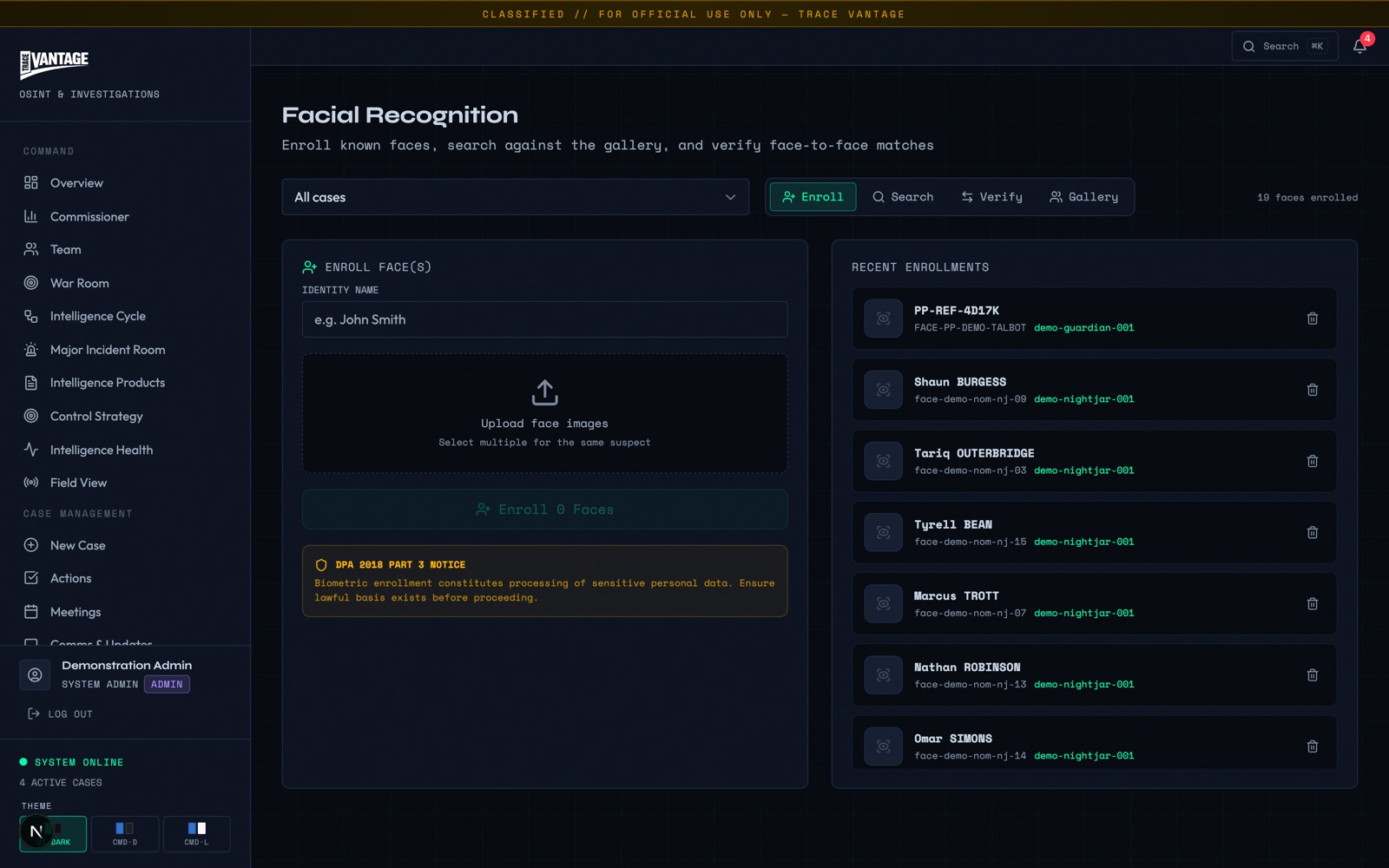
Powerful enough to matter. Governed so it holds up.
Recognition touches identity, and identity is where investigations go wrong when a match is treated as a fact rather than a lead. Trace Vantage puts the controls before the capability, not after it. What the platform is, and is not, is stated plainly below.
Your gallery, not a national database
Face matching runs against the force's own enrolled gallery: case images, cross-case material and a defined public-protection watchlist. It is not a search of a national or blanket criminal database, and it does not reach into third-party databases.
Justified and authorised, every time
Every face search requires a recorded necessity and proportionality justification and an authorising rank before it runs. There is no unattributed, one-click search.
Audited under DPA 2018 s.62
Every search is written to a Data Protection Act 2018 s.62 audit log against the operator's identity: who searched, on what basis, under whose authority, and when.
Leads, not identifications
A match is an investigative lead. Human confirmation through due process is required before it is relied on, and the absence of a match is not exculpatory.
Not live surveillance
This is analyst and operator-initiated search, not always-on live facial recognition against passing crowds. Nothing runs without a justified, authorised request.
Inside your boundary
Recognition runs on the force's own infrastructure, on locally hosted models, with seized imagery never routed to an external AI service.
Four capabilities. One governed spine.
Each capability answers a different question, and each inherits the same identity, authorisation and audit controls beneath it.
Facial recognition
Enrol a face into your gallery, search a probe image one-to-many against that gallery, or verify one-to-one. Runs against your enrolled case, cross-case and public-protection watchlist material, never a national database. Usable at the desk and now in the field.
Cross-camera face tracking
Enrol a suspect from a single still, scan recorded video for that face, review the candidate sightings, build a cross-camera sightings timeline, and export a disclosure pack. Operator-initiated against recorded footage the force holds.
Vehicle identification
Make, model and colour recognition, plus number-plate reading (ANPR), to place and connect vehicles across the material in a case. A candidate reading for an analyst to confirm against the source frame.
Content-provenance check
Reads embedded C2PA Content Credentials on submitted images and video to check what a file's provenance actually declares, supporting an assessment of whether media is authentic or manipulated.
Capability 04 is a provenance check: it reads the cryptographic Content Credentials a file carries. It is not a court-grade "this is a deepfake" verdict, and it does not claim a proven synthesis-artefact classifier. It tells you what the file's provenance says, for a human to weigh.
A face search is a justified, authorised, logged act.
Every face search follows one path. It starts with a recorded justification and an authorising rank, runs against your own enrolled gallery, and ends at a human, whose review turns a candidate into a line of enquiry, not an identification.
No search reaches the gallery without a justification and an authorising rank. The gallery is the force's own enrolled material, not a national database. The path always ends at a person, and the whole sequence is recorded under DPA 2018 s.62.
Now the same governed search runs from an officer's phone.
Facial recognition has always run in the office: an analyst enrols a face, searches a probe against the gallery, or verifies one-to-one. It now also runs in the field. From the mobile Field View, an officer captures a face on the phone camera and searches the enrolled gallery, on the same footing as the desk.
The field path carries the same controls as the desk: a recorded justification, an authorising rank, a candidate list rather than an identification, and a s.62 audit entry against the officer's ID. Nothing about being in the field relaxes the governance.
Enrol
Add a face to your gallery from a still or a video frame, with its source and provenance recorded.
Search (one-to-many)
Compare a probe image against the enrolled gallery and return a ranked list of candidates for review.
Verify (one-to-one)
Check whether two images are likely the same person, as support for a reviewer's judgement.
Field capture
Capture a face on the phone camera and run the same authorised, audited gallery search from the mobile Field View.
From a single still to a disclosure pack.
Sightings timeline
Enrol a suspect from one still, scan the recorded video the force holds, review each candidate sighting, and assemble a cross-camera timeline of where and when the subject appears, then export it as a disclosure pack. Every sighting is a candidate for an officer to confirm.
Make, model, colour, plate
Recognise a vehicle's make, model and colour and read its number plate (ANPR) across case material, to place and link vehicles. Readings are candidates checked against the source frame, not standalone assertions.
Content Credentials
Read embedded C2PA Content Credentials on submitted images and video to see what the file's provenance declares, and flag where credentials are missing, broken or inconsistent, to inform a human authenticity assessment.
Cross-camera tracking and vehicle identification run against recorded footage and case material the force already holds. They are operator-initiated, not continuous live surveillance.
Turn a seized video into a searchable, redaction-ready exhibit.
An operator points the pipeline at a video the force already holds, a seized clip or a lawfully downloaded file, and it comes back searchable: what was said, who appears, which vehicles, what objects, where, and what was heard. Every output is a candidate for a person to confirm, and the whole run is hashed and audited before anything is relied upon.
Transcript you can search
The spoken audio is transcribed on-box, so the words in a clip become searchable text, with each line tied back to its point in the video for a reviewer to check against the source.
Face hits against your gallery
Faces detected in the footage are matched against the force's own enrolled gallery, returning ranked candidate sightings for review rather than an automatic identification.
Plates and objects, read in frame
Number plates (VRN) and objects of interest are read from the footage as candidate readings, each checked against the source frame before it counts for anything.
Where, and what was heard
Location cues in the footage support a placement for a human to weigh, and audio-event detection flags sounds such as raised voices or a gunshot-like report for an analyst to assess.
Bystander-redaction disclosure pack
The analysis exports a disclosure pack with uninvolved bystanders redacted and a methodology appendix recording every model, tool version and cost that touched the video.
Video intelligence is operator-initiated, run on footage the force already holds, inside the force boundary. Seized imagery is not routed to an external AI service, and every result is a lead for a person to confirm, not an automatic finding.
The questions your DPO and information-assurance team will ask.
What is the gallery searched against?
The force's own enrolled material: case images, cross-case material and a defined public-protection watchlist. Not a national or blanket criminal database, and not third-party databases.
Can anyone just run a face search?
No. Each search requires a recorded necessity and proportionality justification and an authorising rank before it runs. Access follows the force's role model.
How is a search recorded?
Every search is written to a DPA 2018 s.62 audit log against the operator's identity, capturing the basis, the authority and the time, and is available for the force's own review and disclosure.
Is a match an identification?
No. A match is an investigative lead. Human confirmation through due process is required before it is relied on, and the absence of a match is not exculpatory.
Is this live facial recognition?
No. Recognition is analyst and operator-initiated search against material the force holds, including from the field, not always-on surveillance of passing crowds.
Does the deepfake check prove a file is fake?
No. It reads C2PA Content Credentials to report what a file's provenance declares. It is not a court-grade synthesis verdict; an on-box synthesis-artefact classifier is emerging and not adopted as proof.
Where does the imagery go?
Recognition runs inside the force boundary on locally hosted models. Seized imagery is not routed to an external AI service.
Who controls retention?
Enrolled galleries, watchlists and search records are held under force retention policy, reviewable and disposable on the force's own schedule.
See Governed AI › for the full model-governance and audit picture, and Data Sovereignty › for where the data lives.
Recognition you can put in front of a court.
Faster leads
A face or a vehicle turns into a line of enquiry in minutes, from the desk or the field, without loosening a single control.
Answerable use
Every search carries its justification, its authority and its operator in a s.62 record, so the use of recognition is defensible in the same way as any other investigative step.
Honest limits
Leads not identifications, your gallery not a national database, provenance checks not deepfake verdicts. The platform states what it does, and what it does not.
Walk the recognition controls through with your assurance team.
See how facial recognition, cross-camera tracking, vehicle identification and content-provenance checks map onto your authorisation, retention and DPA 2018 s.62 obligations.