One governed system, end to end.
Trace Vantage spans the full investigation lifecycle in a single environment. Every stage carries its provenance forward, so material is ready for disclosure scrutiny when it needs to be, not reconstructed afterwards.
Six families on one governed backbone.
Investigation Command
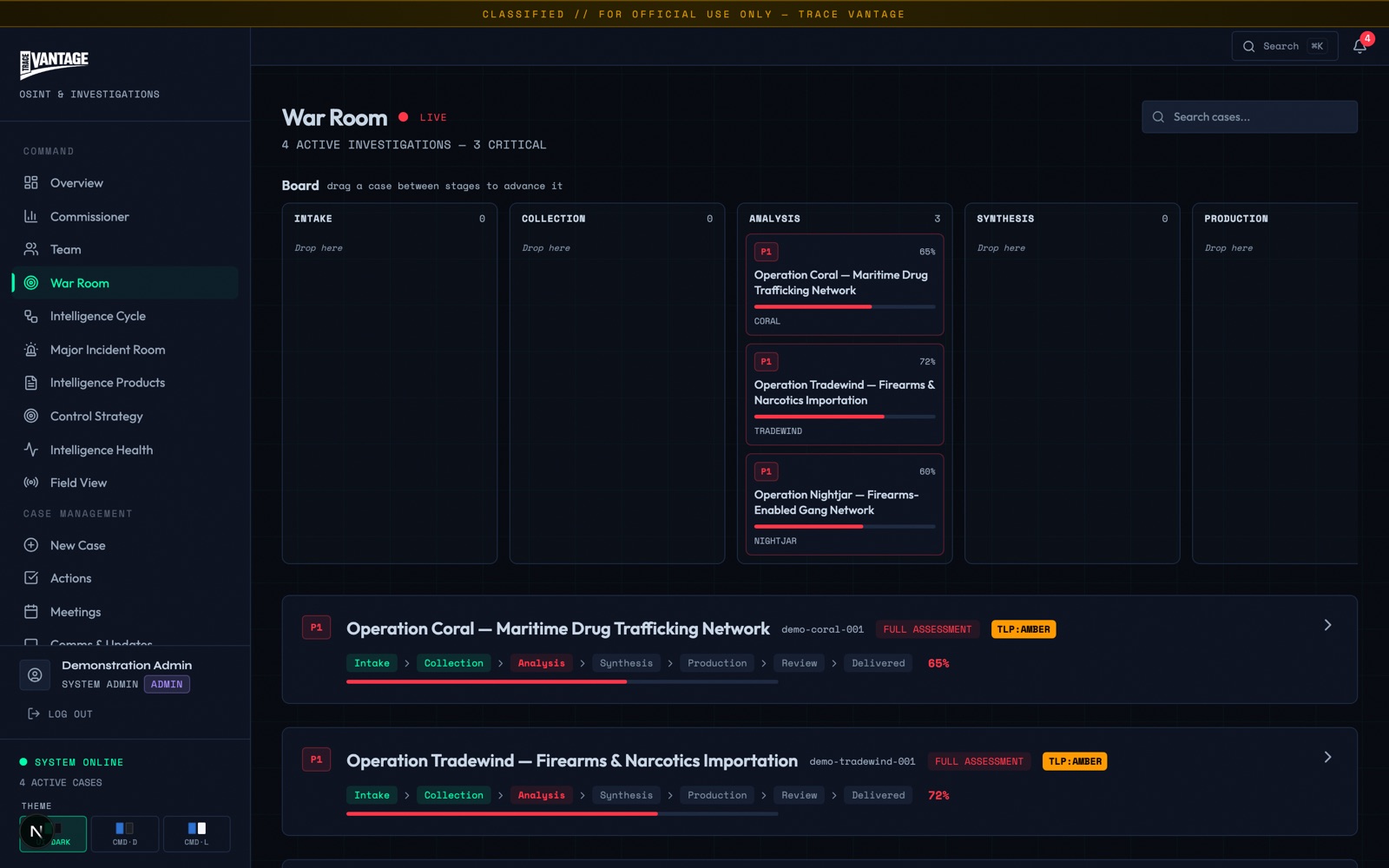
Multi-entity case intake, actions and workflow stages, war room, timelines, case-readiness scoring, and command oversight across live operations. Investigations ›
Collection & Data Interrogation
Open-source collection, provider-return ingestion, digital-forensic parser support, and cross-platform search into one cross-referenced, searchable timeline you can question in plain language.
Intelligence & Analysis
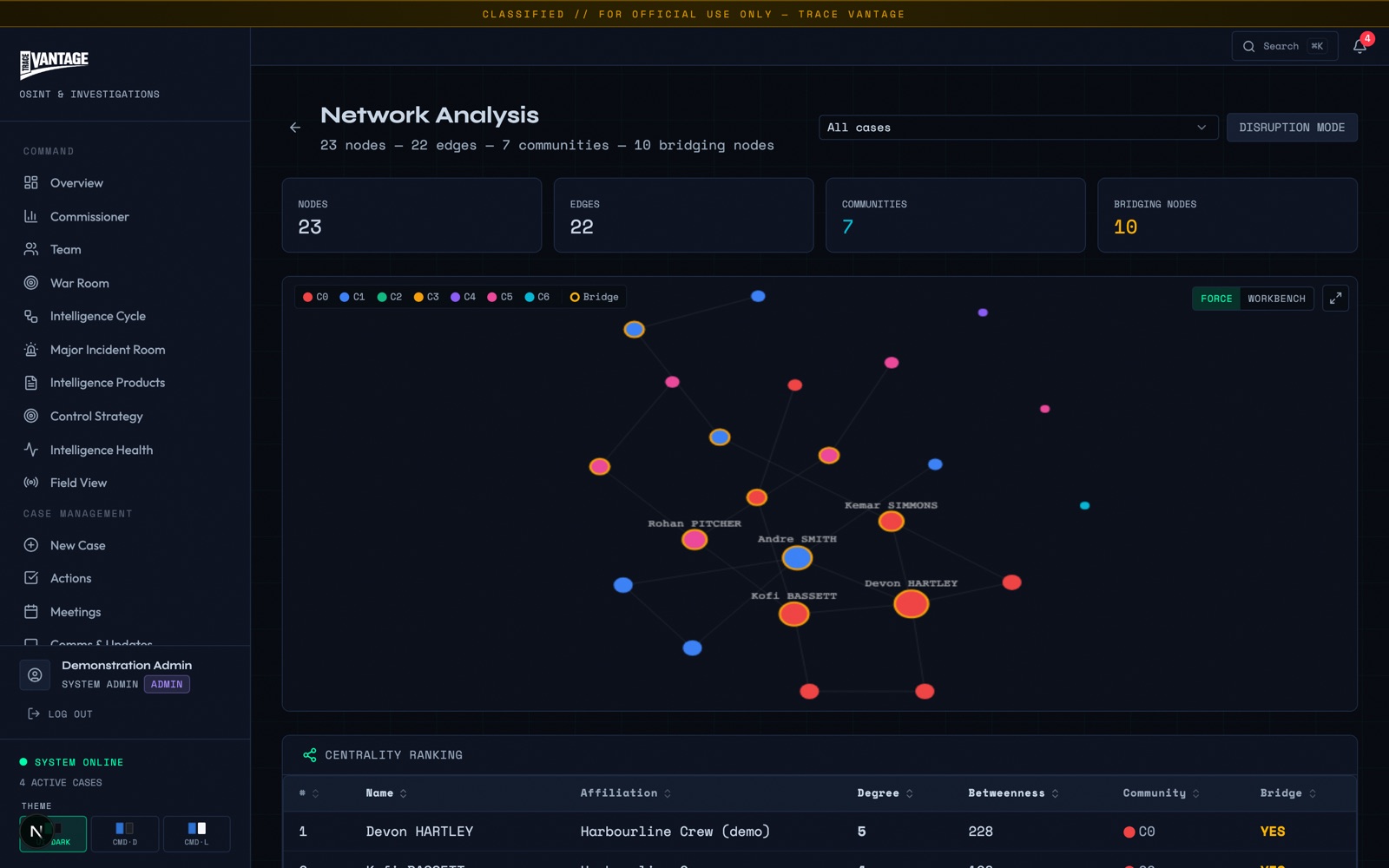
Entity resolution, link and network analysis, OCG mapping, communications data, financial and crypto analysis, and geospatial, maritime and aviation intelligence. Analysis ›
Evidence & Disclosure
Evidence vault, hashing and provenance, exhibits, disclosure schedules, court bundles, and legal-process / provider-return tracking. Evidence ›
Secure Collaboration
Case rooms, direct messages and microcells, handling classifications, evidence promotion, retention and audit. Collaboration ›
Builder & Integration
Force-designed workflows, internal-system connectors, APIs, jurisdiction packs, and interoperability including reporting interfaces. Builder ›
AI runs across these families under governance, entity extraction, research, summarisation and specialist agents, always with human approval and model-use declarations. See Governed AI ›
What's native, what's integrated, what depends on a source.
Not every capability runs the same way. The platform labels each one so a force always knows what it is relying on.
Native capability
Built into the platform and available on installation, running entirely within the force environment. Case command, evidence vault, entity resolution and core link analysis are native.
Available integration
Delivered through an approved connector to a system or service the force already operates or licenses, for example financial or communications-data analysis.
Requires approved data source
Depends on an external feed the force is lawfully authorised to use, for example geospatial, maritime or advertising-derived intelligence.
Full detail on which capability sits in which category is set out on Intelligence & Analysis ›. Underlying inventory includes a broad OSINT toolset, multiple data parsers and a library of specialist AI agents; jurisdiction-dependent availability and force policy apply throughout.
Connects to what the force already runs.
Identity provider
SSO and MFA via the force's existing directory (SAML or OIDC), not a parallel identity system.
Records & case systems
Approved connectors to existing records-management and case systems, under the same access and audit model.
Digital forensics
Import paths for standard forensic-extraction formats into the platform's parsing and timeline tools.
Reporting & BI
Structured export and reporting interfaces for a force's existing analytics and reporting tools.
Adapted to your legal and procedural framework.
Jurisdiction packs
Doctrine, forms and disclosure requirements configured to the force's jurisdiction. Configurable packs cover England & Wales, Bermuda, the Cayman Islands, Anguilla and Jamaica, alongside US federal practice. Packs for the British Virgin Islands and the US Virgin Islands are being stood up as configurable packs, not as certified or proven compliance.
Configurable, not hard-coded
Legal and procedural requirements are configuration, so they can be updated as doctrine changes without a platform migration.
Local data residency
Deployment stays within the jurisdiction's own infrastructure under the sovereignty model. See Data Sovereignty ›
From a provider return to a disclosure schedule.
Return arrives
A provider return is ingested and parsed into structured data.
Linked to case
Entities resolve against the existing case picture.
Analysed
Link and communications analysis surface relevant material.
Reviewed
An analyst confirms findings; AI assistance is logged.
Promoted
Relevant material is promoted to the evidence vault.
Scheduled
Disclosure schedule generated from the governed record.